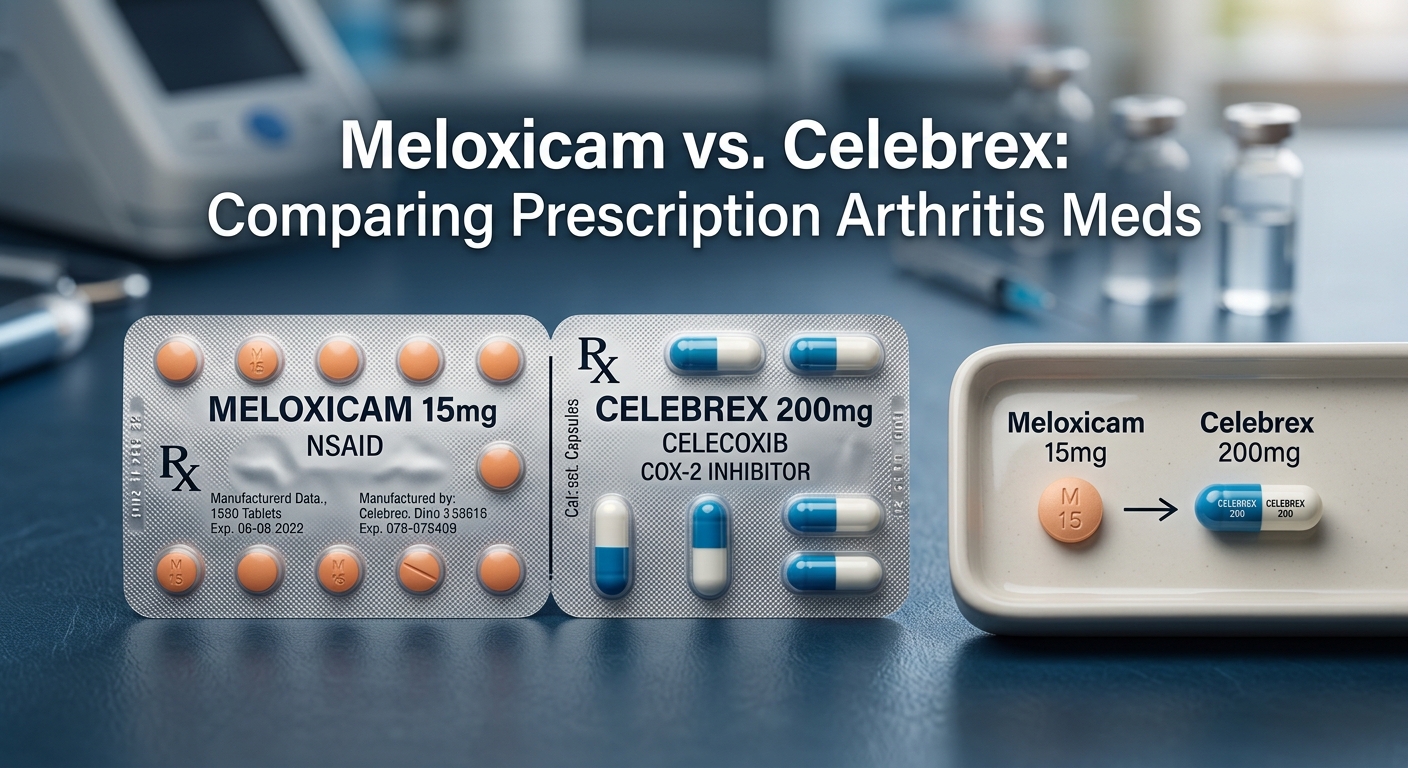
Meloxicam vs. Celebrex: Comparing Prescription Arthritis Meds
By Frankie Sze| 5/2/2026
Introduction: The Battle of the Prescription NSAIDs
For millions of Americans living with the persistent ache of chronic arthritis, the transition from over-the-counter (OTC) pain relievers to prescription-strength non-steroidal anti-inflammatory drugs (NSAIDs) often marks a critical turning point in disease management. As noted in The Freedom Center, “Meloxicam and ibuprofen are both NSAIDs that reduce pain and inflammation, but meloxicam is prescription-only while ibuprofen is available over-the-counter.” While traditional agents like ibuprofen served as a first line of defense, the clinical limitations of OTC options often necessitate the efficacy offered by meloxicam and celecoxib.
Meloxicam was originally developed as a more selective alternative to non-selective NSAIDs to mitigate gastrointestinal side effects, and today it remains FDA-approved for osteoarthritis, rheumatoid arthritis, and juvenile rheumatoid arthritis. Because meloxicam has a half-life of 15 to 20 hours, it supports convenient once-daily dosing, though patients should be aware that it takes several days of consistent use to achieve steady-state pain control—a process detailed in our Meloxicam 101: Your Daily Guide to Steady Joint Relief. In contrast, celecoxib, a COX-2 inhibitor, offers a swifter onset, reaching peak blood concentration in approximately three hours.
The choice between these two therapies is increasingly influenced by clinical safety profiles and shifting payer landscapes. The relative risk for cardiovascular events is reported at 1.06 for celecoxib, compared to 1.25 for meloxicam. Furthermore, financial accessibility is evolving; while brand-name Celebrex can cost between $1,100 and $1,200 without insurance, generic celecoxib typically ranges from $25 to $50. The landscape is shifting further as insurance formularies evolve; for instance, Cigna’s step-therapy policy removed Celebrex from its mandatory trial list effective July 1, 2025. As we look toward 2026, these policy changes suggest a future where targeted, long-term relief is more attainable for patients navigating the complexities of chronic joint pain.
Mechanism Spotlight: What Does ‘COX-2 Selective’ Actually Mean?
To understand the clinical landscape of modern analgesics, one must distinguish between the varying degrees of COX-2 inhibition offered by meloxicam and celecoxib. Meloxicam was originally developed as a more refined alternative to traditional, non-selective NSAIDs like ibuprofen, aiming to mitigate gastrointestinal toxicity while retaining therapeutic efficacy. As noted by experts, “Meloxicam targets the COX-2 enzyme, reducing inflammation and pain with fewer stomach side effects than many traditional NSAIDs.” However, it is important for patients to recognize that meloxicam possesses ‘preferential’ rather than absolute selectivity; it maintains a half-life of 15 to 20 hours, which supports convenient once-daily dosing, though it often requires several days of consistent use to achieve steady-state pain control.
In contrast, celecoxib represents a more highly targeted approach to COX-2 inhibition. With a peak blood concentration achieved in approximately 3 hours, its pharmacokinetic profile differs significantly from that of meloxicam. Clinicians often weigh these biochemical profiles against cardiovascular risk markers, where data shows a relative risk for cardiovascular events at 1.25 for meloxicam compared to 1.06 for celecoxib. While meloxicam remains FDA-approved for osteoarthritis, rheumatoid arthritis, and juvenile rheumatoid arthritis, the path to accessing these therapies is shifting. While most insurance plans historically mandate a trial of generic NSAIDs, the administrative landscape is evolving; for instance, Cigna’s step-therapy policy removed Celebrex from its mandatory trial list effective July 1, 2025. This, paired with a significant price disparity—where brand-name Celebrex may cost between $1,100 and $1,200 without insurance compared to $25 to $50 for generic celecoxib—suggests that upcoming 2026 formulary changes may finally improve patient accessibility to these targeted anti-inflammatory agents.

Dosing and Daily Routine: Meloxicam vs. Celebrex
When managing chronic pain associated with osteoarthritis, rheumatoid arthritis, or juvenile rheumatoid arthritis, the rhythm of a patient’s medication schedule is often as critical as the drug’s efficacy. Meloxicam, originally developed to offer a more selective alternative to traditional non-selective NSAIDs like ibuprofen, is characterized by its pharmacokinetic profile that inherently supports once-daily dosing. As noted by medical experts, “Meloxicam takes a bit longer to reach peak levels (up to about 5–6 hours), but it has a longer half‑life of around 15–20 hours. It takes several days to see the full effects.” This extended half-life provides a consistent therapeutic baseline, though patients must be prepared for a multi-day ramp-up period to achieve steady-state pain control.
In contrast, celecoxib—the active ingredient in Celebrex—reaches peak blood concentration in approximately 3 hours. While this faster onset can be advantageous for acute flare-ups, it may necessitate more frequent daily dosing compared to the sustained release of meloxicam. Furthermore, clinicians must weigh these pharmacokinetic differences against safety profiles; current data suggests a relative risk for cardiovascular events of 1.25 for meloxicam, compared to 1.06 for celecoxib.
Economic barriers and insurance mandates have historically dictated these choices, with many plans requiring patients to trial generic NSAIDs before covering brand-name COX-2 inhibitors. While brand-name Celebrex can reach costs between $1,100 and $1,200 without insurance, the generic celecoxib is much more accessible at $25 to $50. Looking forward, the landscape of accessibility is shifting. Policy changes, such as Cigna’s move to remove Celebrex from its mandatory step-therapy list effective July 1, 2025, signal a potential loosening of access requirements that may soon offer patients and providers greater flexibility in selecting a daily regimen that best aligns with their specific clinical needs.

The Cost Barrier: Generic Availability and Insurance ‘Step Therapy’
For patients navigating the financial landscape of chronic pain management, the economic disparity between medication options remains a significant obstacle. While brand-name Celebrex can command prices between $1,100 and $1,200 without insurance, generic celecoxib is typically available for a fraction of that cost, ranging from $25 to $50, as noted by industry pricing guides. This stark price gap is why many insurance providers enforce ‘step therapy’ protocols, requiring patients to first prove the inadequacy of lower-cost alternatives like meloxicam before approving more targeted COX-2 inhibitors.
Meloxicam, originally developed to offer a more selective gastrointestinal profile than traditional non-selective NSAIDs, is FDA-approved for the treatment of osteoarthritis, rheumatoid arthritis, and juvenile rheumatoid arthritis. Its pharmacokinetics are well-suited for daily management, featuring a half-life of 15 to 20 hours that supports once-daily dosing, though patients should be aware that it often requires several days of consistent use to achieve steady-state pain control. In contrast, celecoxib reaches peak blood concentration in approximately 3 hours, offering a different clinical trajectory.
Clinical decision-making is further complicated by cardiovascular risk profiles, with relative risk for events reported at 1.06 for celecoxib compared to 1.25 for meloxicam. Despite these nuances, formulary restrictions have long favored the generic meloxicam. However, the landscape is shifting; for instance, Cigna’s step-therapy policy removed Celebrex from its mandatory trial list effective July 1, 2025. As insurance formularies continue to evolve throughout 2025 and 2026, such changes reflect a growing recognition that accessibility is as vital to patient outcomes as the pharmacological properties of the drugs themselves.
Safety Profiles: Comparing Heart and Stomach Risks
When navigating the pharmacological landscape of arthritis management, the choice between meloxicam and celecoxib often hinges on a delicate balance between gastrointestinal (GI) safety and cardiovascular risk. Historically, meloxicam was developed as a more selective alternative to non-selective NSAIDs to mitigate GI irritation; it is currently FDA-approved for osteoarthritis, rheumatoid arthritis, and juvenile rheumatoid arthritis. Because of its 15- to 20-hour half-life, meloxicam supports once-daily dosing, though patients should be advised that it requires several days of consistent use to achieve steady-state pain control. In contrast, celecoxib, a COX-2 inhibitor, offers a different pharmacokinetic profile, reaching peak blood concentration in approximately 3 hours.
Clinical decision-making is increasingly informed by the comparative cardiovascular safety of these agents. As noted in clinical literature, large meta-analyses and systematic reviews report a relative risk for cardiovascular events of about 1.06 for celecoxib versus 1.25 for meloxicam. While these metrics provide essential guidance, the practical application of these therapies is frequently mediated by insurance mandates. Although most plans continue to enforce step-therapy requiring a trial of generic NSAIDs before approving COX-2 inhibitors, the landscape is shifting. Changes in 2025 and 2026 insurance formularies—such as Cigna’s policy change effective July 1, 2025, which removed brand-name Celebrex from its mandatory trial list—may enhance access to these treatments. This is particularly relevant for patients considering cost, as brand-name Celebrex can range between $1,100 and $1,200 without insurance, whereas generic celecoxib typically remains an affordable alternative at $25 to $50.
Conclusion: Making the Choice with Your Doctor
When navigating the treatment landscape for chronic inflammatory conditions, Meloxicam remains the standard clinical starting point. With a half-life of 15 to 20 hours and a profile that requires several days of consistent use to achieve steady-state pain control, it offers a reliable, once-daily approach to symptom management. As noted in expert clinical analysis, “Meloxicam is generally considered stronger for chronic inflammatory pain conditions and offers once-daily dosing.” For more details on maintaining this regimen, see our guide on Meloxicam 101: Your Daily Guide to Steady Joint Relief.
However, Celebrex functions as a specialized alternative, particularly for those concerned with gastrointestinal profiles. While brand-name Celebrex can reach costs between $1,100 and $1,200 without insurance, the generic celecoxib—which reaches peak concentration in just three hours—is significantly more accessible, typically priced between $25 and $50. Patients must balance these factors against cardiovascular safety data, which reflects a relative risk of 1.06 for celecoxib compared to 1.25 for meloxicam.
The regulatory landscape is also evolving; effective July 1, 2025, Cigna’s step-therapy policy removed Celebrex from its mandatory trial list, signaling a potential shift toward greater accessibility for specialized inhibitors in the coming years. Despite this, most insurance plans still mandate a trial of generic NSAIDs before covering high-cost alternatives. Whether you are managing osteoarthritis, rheumatoid arthritis, or juvenile rheumatoid arthritis, the decision should be a collaborative one. By discussing these clinical variables with your physician, you can determine if the cost-effective consistency of meloxicam or the specialized profile of celecoxib best serves your individual health goals.