
The Once-Daily Routine: Dosing Made Simple
By Frankie Sze | 5/2/2026
The 24-Hour Advantage: Understanding the Long-Acting Formula
For decades, individuals managing chronic arthritis struggled with the “yo-yo effect” of short-acting nonsteroidal anti-inflammatory drugs (NSAIDs), which necessitated frequent, multi-daily dosing that often led to poor patient adherence and recurring breakthrough pain. Today, clinical practice has shifted toward sustained management. Meloxicam has emerged as a first-line prescription precisely because it is a “long-acting” NSAID, meaning it stays active in your bloodstream for an extended period, compared to other similar medications, according to recent medical comparisons.
The science behind this shift lies in the drug’s pharmacokinetic profile. With a terminal elimination half-life of approximately 15 to 20 hours, meloxicam allows for a once-daily dosing regimen—typically 7.5 mg or 15 mg—that maintains a stable anti-inflammatory baseline. Unlike short-acting agents, peak plasma concentrations occur 10 to 12 hours after administration, and steady-state levels are generally achieved within 3 to 5 days of consistent use. For those transitioning to this regimen, it is important to remember the “12-hour rule”: a missed dose should only be taken if the next scheduled dose is more than 12 hours away. To better understand how this affects your daily routine, you can explore our Meloxicam 101: Your Daily Guide to Steady Joint Relief.
Beyond convenience, the drug’s preferential selectivity for COX-2 enzymes—the proteins primarily responsible for inflammation—may offer a superior profile regarding gastrointestinal tolerability compared to non-selective NSAIDs like ibuprofen. Looking ahead, researchers are increasingly focused on the role of “chronotherapy,” or timing medication to align with an individual’s circadian rhythm of inflammation, which promises even more refined pain control for patients managing chronic conditions.
Morning vs. Evening: Timing Your Dose to Match Your Pain Profile
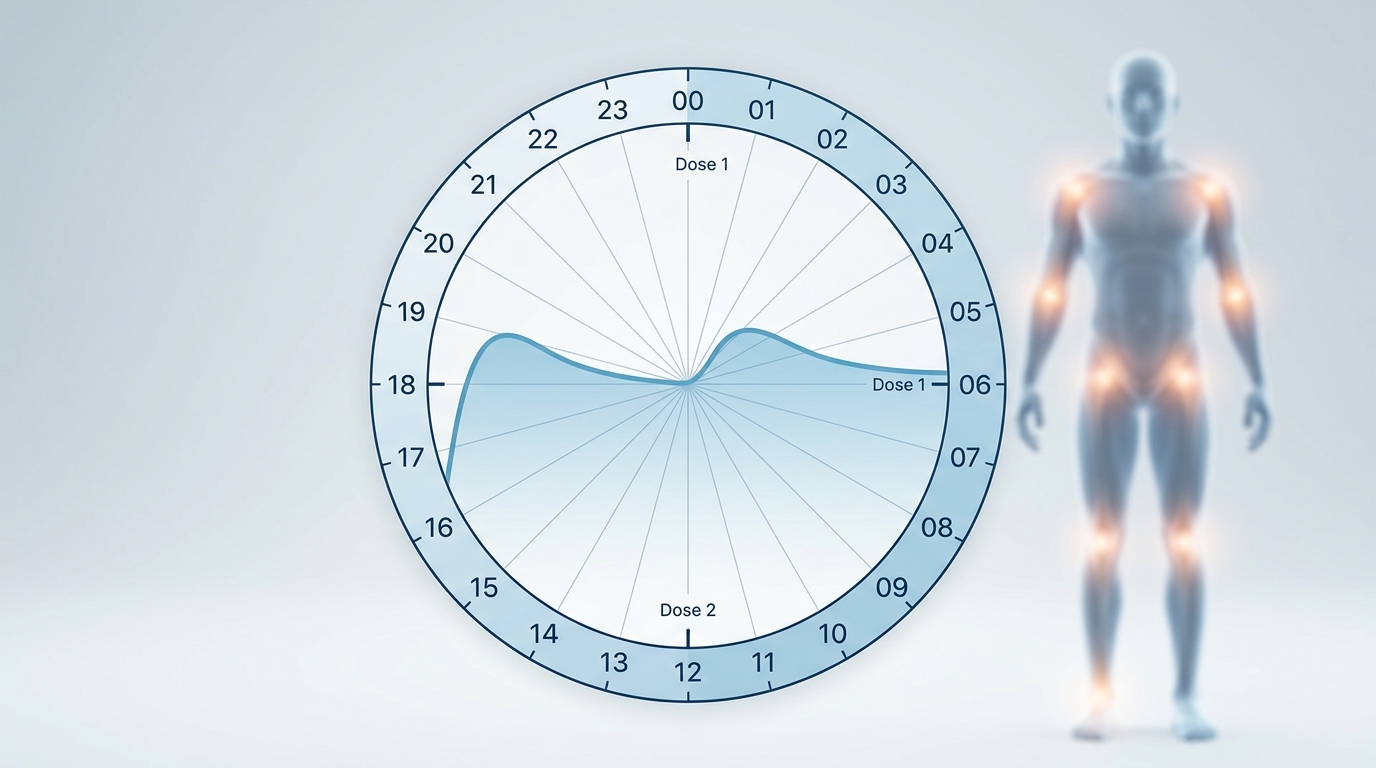
Optimizing the efficacy of meloxicam requires an understanding of its unique pharmacokinetic profile. With a terminal elimination half-life of 15 to 20 hours and a steady-state concentration typically reached within 3 to 5 days, this medication provides the sustained relief necessary for chronic conditions like arthritis. Unlike older regimens that required frequent, short-acting NSAID doses, the once-daily convenience of meloxicam at 7.5 mg or 15 mg allows for strategic chronotherapy. Because peak plasma concentrations (Cmax) occur approximately 10 to 12 hours after ingestion, the timing of your dose can be tailored to align with your body’s specific inflammatory cycle. As noted by clinical experts at Doctronic, “Morning dosing typically works best for patients with daytime activity-related pain, while evening dosing benefits those struggling with morning stiffness and overnight discomfort.”
When implementing this strategy, safety remains paramount. While meloxicam is preferentially selective for COX-2—potentially offering better gastrointestinal tolerability than non-selective alternatives—adherence to the dosing schedule is essential. If you happen to miss a dose, adhere strictly to the “12-hour rule”: only take the medication if your next scheduled dose is more than 12 hours away. By matching your dose to your individual pain profile, you move beyond mere symptom management and toward a more sophisticated, circadian-aligned approach to long-term pain relief.

The Art of Consistency: Simple Habits for Daily Success
In the past, managing chronic inflammation often required complex, multi-dose regimens that frequently resulted in patient non-adherence and breakthrough pain. Today, meloxicam has transformed this landscape, serving as a first-line therapy that leverages a long, 15- to 20-hour terminal elimination half-life to provide sustained relief through once-daily administration. Because steady-state plasma concentrations typically require three to five days of consistent dosing to achieve, establishing a reliable routine is essential for long-term efficacy.
To optimize your regimen, consider the “12-hour rule”: if you happen to miss a dose, you should only take it if the next scheduled dose is more than 12 hours away. While meloxicam is preferentially selective for COX-2, which generally results in less gastric irritation than older, non-selective NSAIDs like ibuprofen, internal comfort remains a priority. According to experts, “Taking meloxicam consistently with food maximizes its effectiveness while protecting your stomach from irritation.” Aligning your 7.5 mg or 15 mg dose with a morning meal can act as a reliable cognitive anchor for your daily habit.
As we look toward the future, the integration of “chronotherapy” may further refine this practice, helping patients time their administration to align with their body’s natural circadian rhythm of inflammation. By anchoring your intake to a daily ritual now, you build the foundation for these more advanced therapeutic strategies.

Handling the ‘Oops’ Moment: A Guide to Missed Doses
Historically, patients managing chronic pain were burdened by complex regimens involving multiple daily doses of short-acting NSAIDs, which often eroded treatment adherence and led to cycles of breakthrough pain. Meloxicam has fundamentally shifted this landscape; as a COX-2 preferential inhibitor, it offers a more favorable profile for gastrointestinal tolerance and, crucially, a once-daily dosing structure that supports steady-state plasma concentrations within 3 to 5 days. However, the convenience of a 24-hour cycle requires precision. With a terminal elimination half-life of 15 to 20 hours and peak plasma concentrations occurring roughly 10 to 12 hours post-administration, maintaining the consistency of your 7.5 mg or 15 mg regimen is vital for sustained anti-inflammatory efficacy.
If you encounter the ‘oops’ moment of a missed dose, clinical caution is paramount. To avoid the risk of toxicity, you must strictly adhere to the 12-hour rule. As outlined in the official Meloxicam Information Sheet, “If you miss a dose, give it when you remember, but if it is closer than 12 hours before the next scheduled dose, either 1) skip the dose you missed and give it at the next scheduled time… Do not double-up.” Attempting to ‘catch up’ by doubling your dose can lead to dangerous levels of the medication in your system. By waiting for the next scheduled interval, you protect your body from unnecessary toxicity while preparing for the future of ‘chronotherapy’—a promising shift toward aligning your medication with your body’s unique circadian inflammatory rhythms.
The Road to Steady Relief: What to Expect in the First Week
When transitioning from the roller coaster of multiple daily doses common with traditional, short-acting NSAIDs to the streamlined once-daily regimen of meloxicam, it is helpful to visualize your treatment as a ‘simmering pot.’ Unlike acute pain relievers that provide an immediate, sharp spike of relief, meloxicam works by maintaining a consistent therapeutic level in your system. With a terminal elimination half-life of 15 to 20 hours, the drug remains active in your body long after the initial peak plasma concentration—which typically occurs 10 to 12 hours post-ingestion—has subsided.
Because the medication relies on this cumulative, sustained approach, you should not expect overnight results. According to clinical data, “Steady-state drug plasma concentrations are reached within 3–5 days” of consistent daily dosing at your prescribed 7.5 mg or 15 mg level (National Center for Biotechnology Information). During this first week, consistency is paramount. To help manage your routine, refer to our Meloxicam 101: Your Daily Guide to Steady Joint Relief for tips on integrating this into your life. Should you forget a dose, remember the ’12-hour rule’: only take the missed dose if you are more than 12 hours away from your next scheduled time.
As we move toward the future of rheumatology, we are increasingly looking at ‘chronotherapy,’ or the practice of aligning doses with your internal circadian rhythm to better combat morning stiffness. By leveraging meloxicam’s preferential selectivity for COX-2—which may offer a more favorable gastrointestinal profile than non-selective alternatives—we are providing a more reliable foundation for long-term care. Keep your ‘simmering pot’ at a steady heat by remaining diligent with your timing, and you will likely see the cumulative benefits solidify by the end of your first full week of treatment.