How Meloxicam Works: Why It Takes Time for Full Relief
By Frankie Sze | 5/1/2026
Introduction: The Patience Paradox in Pain Management
For many living with chronic joint pain, the therapeutic journey is often defined by a stark contrast between expectation and biological reality. Patients conditioned by years of over-the-counter interventions, such as ibuprofen, are accustomed to a rapid pharmacological response—relief within 30 to 60 minutes, though typically fleeting, lasting only 4 to 6 hours. When transitioning to a maintenance therapy like meloxicam, dosed once daily at 7.5 mg or 15 mg, this ingrained cycle of ‘take pill, feel relief’ often leads to early dissatisfaction. Patients frequently monitor their pain levels hourly, forgetting that meloxicam operates on a different, more deliberate timeline. As explained in this comprehensive guide to the two-week timeline for pain relief, “Think of your joint inflammation like a simmering pot of boiling water on the stove. When you finally turn off the heat, the water does not freeze or stop boiling instantly. It takes time for the bubbles to subside.”
This physiological inertia is inherent to the drug’s pharmacokinetics. With an elimination half-life of approximately 20 hours, it takes 3 to 5 days of consistent dosing to achieve steady-state plasma concentrations. While you might seek immediate respite, peak anti-inflammatory benefits in arthritis management generally require 14 days of continuous use, with a standard therapeutic trial spanning 4 to 6 weeks. It is crucial to resist the urge to combine meloxicam with other NSAIDs like ibuprofen, as this significantly escalates the risk of gastrointestinal ulcers and renal impairment. Navigating this transition requires a shift in mindset; for a deeper understanding of how to manage this phase effectively, consult our resource on Meloxicam 101: Your Daily Guide to Steady Joint Relief. By committing to the full trial period, you move beyond the volatility of short-acting pain relievers toward a more stable, long-term maintenance strategy.

The Science of the Shield: Understanding Steady-State Concentration
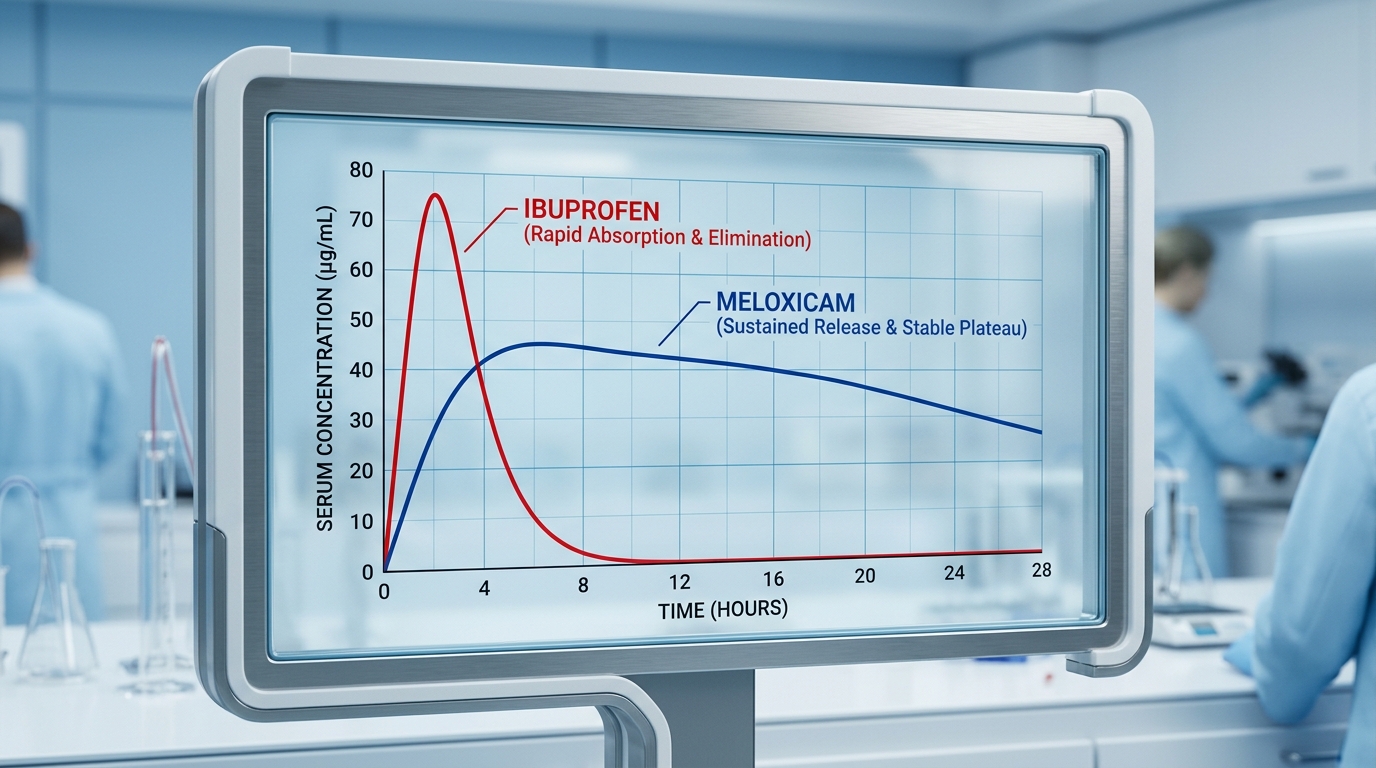
For years, your pain management strategy has likely relied on the rapid, ephemeral relief of ibuprofen or naproxen—medications that act like a sprint, spiking in your blood within an hour but clearing your system entirely in four to six. Transitioning to meloxicam requires a fundamental shift in perspective because it functions more like a marathon runner building stamina. With an elimination half-life of approximately 20 hours, meloxicam remains in your circulation significantly longer than its over-the-counter counterparts. This extended persistence is exactly why once-daily dosing at 7.5 mg or 15 mg is sufficient, but it also explains why you may feel dissatisfied if you are monitoring your pain levels on an hourly basis. You are not waiting for a single dose to ‘kick in’—you are waiting for your body to build a biological reservoir.
The therapeutic efficacy of meloxicam relies on reaching a ‘steady-state,’ the physiological equilibrium where the amount of drug entering your system matches the amount being cleared. As noted in clinical literature, steady-state drug plasma concentrations are reached within 3–5 days of consistent, once-daily administration. This window is a non-negotiable biological requirement; until this concentration is stabilized, your body does not have the ‘shield’ necessary to provide sustained anti-inflammatory control. During these first few days, it is critical to resist the urge to supplement with additional NSAIDs like ibuprofen, as combining these agents significantly heightens the risk of gastric ulcers and nephrotoxicity. By staying the course through this initial period, you are laying the foundation for the 14-day milestone, where many patients finally notice a significant reduction in morning stiffness and swelling, ultimately leading to the 4 to 6-week trial required to fully assess long-term efficacy.
The Timeline of Relief: What to Expect in the First 14 Days
For patients accustomed to the rapid, short-lived relief of over-the-counter medications like ibuprofen, which typically provide analgesic effects within 30 to 60 minutes but wear off in 4 to 6 hours, starting meloxicam requires a shift in mindset. Unlike acute-acting NSAIDs, meloxicam functions differently; it has an elimination half-life of approximately 20 hours, allowing for once-daily dosing at 7.5 mg or 15 mg that maintains a consistent presence in the bloodstream. In the first 3 to 5 days of your daily regimen, your body is working to reach steady-state plasma concentrations. During this initial week, it is common to feel a sense of impatience, but resist the urge to supplement with other NSAIDs. Combining meloxicam with medications like ibuprofen significantly increases the risk of serious complications, including stomach ulcers and kidney damage.
As you move into the second week, consistency is your greatest ally. Research confirms that oral NSAID analgesic effects tend to peak within the first two weeks of therapy and subsequently wane. By the 14-day mark, you should expect to see the most significant reduction in morning stiffness and joint swelling. This milestone is crucial, as it serves as a primary indicator of whether the medication is effectively mitigating your chronic inflammation. While this two-week window is vital for initial assessment, remember that a standard therapeutic trial for meloxicam in arthritis management typically spans 4 to 6 weeks. Patience through this initial fortnight is the key to determining if this medication will become an effective component of your long-term maintenance strategy.

Rescue vs. Maintenance: Why Meloxicam is Not an On-Demand Pill
For patients long accustomed to the near-instant gratification of over-the-counter NSAIDs, starting meloxicam can be an exercise in frustration. Many individuals arrive at their first prescription expecting the same rapid-fire response they experienced with ibuprofen, which typically provides relief in 30 to 60 minutes but carries a fleeting effect of only 4 to 6 hours. As noted by experts at the The Freedom Center, “Ibuprofen works quickly for acute pain relief but requires multiple doses throughout the day for sustained effect.” Meloxicam, however, functions on an entirely different physiological clock.
Because meloxicam has an elimination half-life of approximately 20 hours, it is engineered for long-term consistency rather than acute rescue. When you take your once-daily dose of 7.5 mg or 15 mg, you are not chasing a sudden spike in pain; you are building a reservoir of anti-inflammatory protection. It takes 3 to 5 days of consistent, once-daily dosing to achieve steady-state plasma concentrations, and the true, peak benefits for arthritis often remain elusive until after 14 days of continuous use. This is why physicians emphasize a 4 to 6-week therapeutic trial to truly gauge efficacy.
The common mistake of supplementing a new meloxicam regimen with extra doses of ibuprofen is clinically dangerous. Combining these medications significantly elevates the risk of severe gastrointestinal issues, such as stomach ulcers, and places undue stress on renal function. To reach the future success of reduced morning stiffness and joint swelling, patients must shift their mindset: view meloxicam as the foundation of your baseline health, and reserve the concept of ‘rescue’ medication only for specific, physician-approved scenarios that do not involve stacking NSAIDs.
Conclusion: Building a Higher Floor for Daily Movement
Transitioning from the rapid-fire relief of over-the-counter NSAIDs like ibuprofen—which work in 30–60 minutes but fade within 4–6 hours—to the steady-state approach of meloxicam requires a recalibration of expectations. If you are currently monitoring your pain levels hourly, it is time to shift your focus toward the long-term horizon. Meloxicam reaches steady-state plasma concentrations within 3 to 5 days, and while its 20-hour half-life provides consistent coverage with a once-daily 7.5 mg or 15 mg dose, it is not a quick fix for acute spikes in pain. It is imperative to remember that combining meloxicam with other NSAIDs, such as ibuprofen, does not expedite relief; instead, it significantly compounds the risk of gastrointestinal ulcers and renal damage.
As noted in our guide, Meloxicam 101: Your Daily Guide to Steady Joint Relief, consistency is the mechanism of action here. You should look toward the 14-day milestone, where peak anti-inflammatory benefits typically begin to address morning stiffness and joint swelling. As stated by clinical guidelines for arthritis management, “For mild inflammatory pain in arthritis, a 4-6 week course is typically recommended” to truly evaluate the medication’s efficacy. By committing to this trial period, you are not chasing temporary relief; you are building a higher, more stable floor for your daily movement. Stay the course, track your progress over weeks rather than hours, and consult with your physician to determine if this regimen will serve as your reliable foundation for the long term.